Do Doctors and Scientists Need to Worry About Artificial Intelligence?
In the first half of 2026, we have seen a variety of trends compete for a permanent spot in our brains: a baby monkey named Punch who rose to fame after he was photographed cuddling with a stuffed animal; oval-shaped prescription glasses that have taken online influencers by storm; the rise of sports betting, breaking records with the beginning of the FIFA World Cup.
So, maybe you don’t subscribe to fashion TikTok, and maybe you’re not into sports (I hope we all can appreciate baby animals).
Still, there is one undeniable trend in 2026 that has garnered the attention of Americans nationwide—the increased use of artificial intelligence in the private and public sectors.
Artificial intelligence may feel like an afterthought for those of us in the Healthcare and Life Sciences Career Interest Community. However, as your Career Success Strategist, I am here to report that it might be worthwhile to bring AI to the forefront of your mind.
TREND: Artificial intelligence is augmenting human capabilities in healthcare and life science.
Medical groups like Permanente Medical Group and hospital systems such as Cooper University Health Care are streamlining clinical documentation through ambient AI. Radiology, the medical specialty that uses imaging technology to diagnose and treat diseases and conditions, has been capitalizing on advances in AI and machine learning for most of the past two decades to improve diagnostic capabilities, and it's not showing any signs of stopping.
In the pharmaceutical industry, AI is being used in drug design as demonstrated by researchers at Massachusetts Institute of Technology (MIT) who designed more than 36 million compounds using Generative AI to combat antibiotic-resistantbacteria.
These are just a few of the ways AI is being used in healthcare and life science; many more applications exist.
Although AI is not completely replacing us in these sectors, technology will impact the future of healthcare and life sciences. In other words, we must be open to working with AI, not against it, especially if we want to be competitive in a tough job market.
For example, Pfizer lists “experience using common AI tools, including generative technologies such as ChatGPT or Microsoft Copilot, to support problem solving,” as one of their nice-to-have qualifications in several of their Scientist and Sr. Associate Scientist position descriptions. With more organizations investing in AI, we will likely continue to see this trend in future job descriptions.
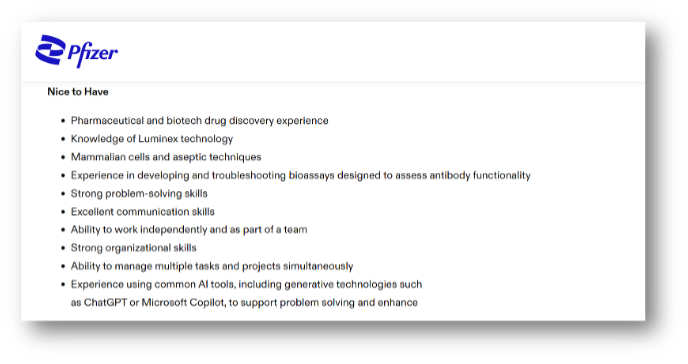
Nice to Have
• Pharmaceutical and biotech drug discovery experience
• Knowledge of Luminex technology
• Mammalian cells and aseptic techniques
• Experience in developing and troubleshooting bioassays designed to assess antibody functionality
• Strong problem-solving skills
• Excellent communication skills
• Ability to work independently and as part of a team
• Strong organizational skills
• Ability to manage multiple tasks and projects simultaneously
• Experience using common Al tools, including generative technologies such as ChatGPT or Microsoft Copilot, to support problem solving and enhance
So how do we work with AI during our career development journey at Rutgers?
Learn the fundamentals of AI
While you do not have to become an expert in AI in your four years of university, take advantage of the resources available that are designed to help you understand the core concepts.
Did you know that Rutgers students have free access to LinkedIn Learning? Consider checking out the following courses to help you get started:
Introduction to Artificial Intelligence
Get to know commonly used technologies like ChatGPT, Google Gemini, and Microsoft Copilot
As a Rutgers student, you also have access to Microsoft Copilot Chat and Google Gemini at no additional cost. Not to mention, your data won't be used to train the models. For more information on AI usage at Rutgers, click on this link: https://it.rutgers.edu/ai/guidance-on-the-use-of-ai-at-rutgers/
Before diving into the software, consider watching these helpful introduction videos on LinkedIn Learning
What is Copilot? An Overview of Microsoft’s AI Tools
Empower Your Productivity with Google Gemini
Practice using AI in your everyday life
The fun part comes when you start experimenting with the technology available to you. Below are some videos on LinkedIn Learning that can help you maximize AI's full potential
Prompt Engineering with ChatGPT
Everyday AI: 15 Practical Skills to Build Confidence with AI
Apply AI to contexts within healthcare and life science
At the Office of Career Exploration and Success, we firmly believe in experiential learning, the idea that one learns best by doing. Our team is here to support you throughout your career development journey, including when you are ready to participate in opportunities such as internships, externships, research, part-time work, or volunteering. We want to help connect you to relevant experiences where you can apply and strengthen your technological skills.
Use this link to schedule an appointment with a specialized Career Success Strategist for healthcare and life science, or another career advisor: https://careers.rutgers.edu/students-and-alumni#appointments
If you are not ready to participate in an experiential learning opportunity, consider following the news to stay informed about how AI is being used in both healthcare and life science. The websites listed below are some of my favorite sources.
Association of American Medical Colleges
You might also consider completing a personal project that allows you to apply your technological skills in a healthcare or life science setting. A common misconception is that your resume should only include paid work experience. Projects are a great way to demonstrate your skills and abilities, even if you complete them outside of class.
Websites like Kaggle are great for sourcing real-life datasets that you can download, then clean, analyze, and visualize for your own learning, research, and practice. There are also many competitions you can participate in for a monetary prize.
Looking for a more realistic experience? Consider exploring Forage, a free job simulator website that partners with real companies to provide you with a task, project, or assignment that mimics the type of work you would do if you worked at their organization. Fun fact: Some employers pay close attention to those who complete their simulations!
Click here to review a biology research job simulation by LifeArc.
AI can be a challenging subject to discuss, but it is important to be equipped with the knowledge and skills needed to thrive professionally in the fields of healthcare and life science.
Schedule an advising appointment on Handshake:
Click the "Career Center" tab
Click the "appointments" button followed by "schedule new appointment"
Choose any of the following appointment types:
Resume/cover letter reviews: Resume/cover letter reviews (Healthcare and Life Sciences)
Interview assistance (internships/jobs): interview strategies/mock interview (Healthcare and Life Sciences)
Internship/co-op search strategies: internship search strategies (Healthcare and Life Sciences)
Job search strategies: job search strategies (Healthcare and Life Sciences)
LinkedIn/social media coaching: networking strategies in-person and online (Healthcare and Life Sciences)
Offer negotiations: offer negotiations (Healthcare and Life Sciences)
Graduate school planning and admissions preparation: graduate school planning and admissions preparation (health professions)
Graduate school planning and admissions preparation: personal statement preparation (health professions)
Pick a date, time, and format that works best for you
Want tailored career content based on your career interests? Sign up for one of our 7 Career Communities on Handshake to receive a regular email newsletter featuring tailored workshops, events, alumni spotlights, and job postings.
Click your profile picture in the upper right-hand corner
Click “career interests”
Scroll down to the “choose up to five career communities” question
Select “Healthcare and Life Science”
Click “save”